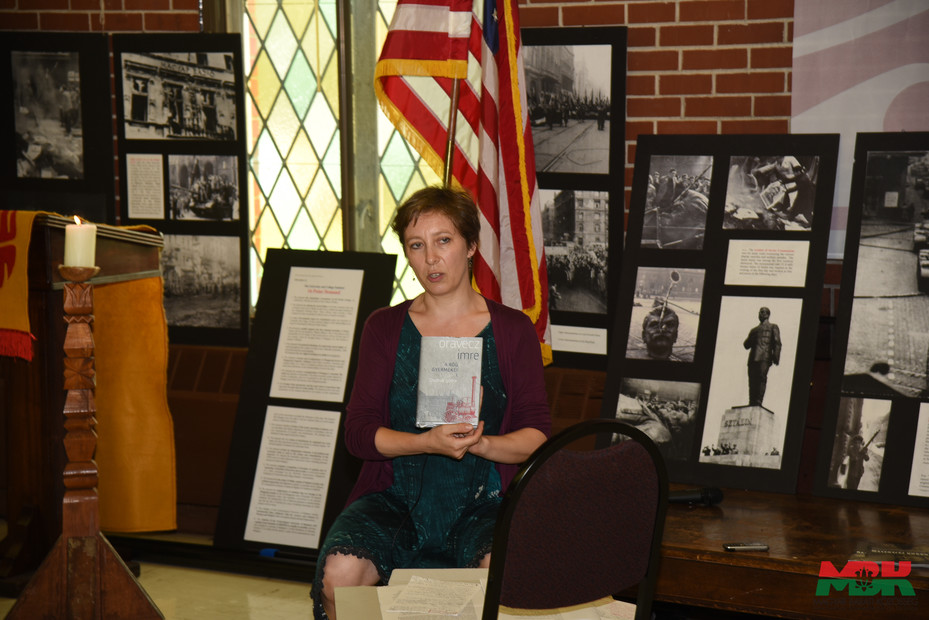
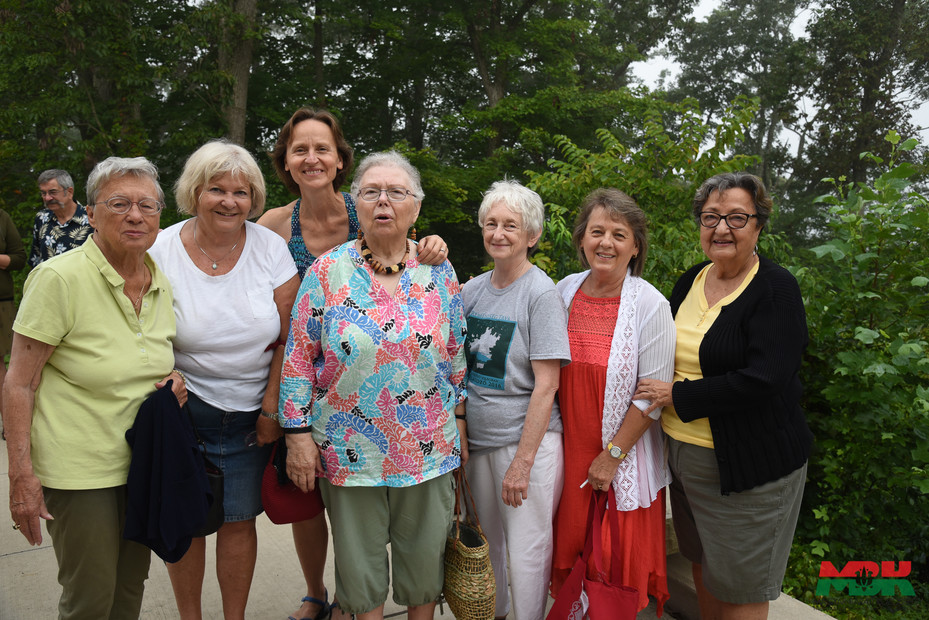
In memoriam: Clara Györgyey: Writer and translator who specialised in the theatre
Klara Takács, writer and translator: born Budapest 23 May 1933; married Ferenc Györgyey (two daughters); died Wallingford, Connecticut 11 January 2010.
The Mediterranean - when I hear this name the first image that comes into my mind is the sea. My first encounter with the sea happened to be in the Mediterranean, on the Montenegrine coast. It was really an encounter in the broader sense of the word, not only a meeting, but also a duel. It was late night when after long hours of hitchhiking in the shadow of rattling guns and walking along untrodden paths in the Black Mountains at last I arrived at the coast. I was staggering in the darkness, hardly could see any stars in the overcast sky and public lighting also was switched off in fear of a possible missile raid. My flask was empty and I felt tortured by thirst. The camping, the address of which I had found in a ten-year-old travel book, still existed though, but the door was locked and the porter had gone. The tap was within arm’s reach yet it seemed unreachable.
June 4, 2009
The punitive treaty of Trianon, which tore Hungary asunder in violation
of the vaunted principle of self-determination, is often thought of as
a tragic historical event that has little or no relevance today. For
some, Trianon is an emotionally laden event, while for others it is at
best, an uncomfortable reminder of a past injustice that needs to be
“gotten over.” Since the consequences of Trianon are still with us,
however, it cannot be ignored.
Preface to Gregory L. Nehler’s A Hungarian Community in Limbo
When I was Associate Instructor of Hungarian at Indiana University,
Bloomington between 1978 and 1981, I began a research project on the
bilingualism of Hungarians in South Bend, IN. I tape-recorded scores of
interviews in Hungarian and my friend, Greg Nehler, an IU student at
the time, conducted scores in English. This project resulted in several
published articles and one book that I wrote (Fejezetek a South Bend-i
magyar nyelvhasználatból, Budapest, 1990). What follows below is an
unpublished paper by Greg Nehler, the typescript of a talk prepared for
the Hungarian Cultural Association of Chicago in May 1981. This
typescript deserves more visibility than it has in my project files,
therefore I have asked Professor Louis Éltető of Portland, OR, the man
responsible for infusing Nehler with great eagerness to learn Hungarian
language and culture, to publish it on this homepage. I am publishing
this with Nehler’s permission.
Over the last three decades Nehler’s talk has gathered some historical
importance in as much as it is a record of a Hungarian community that
has since all but vanished. One of the many signs of vanishing is that
St. Stephen’s Catholic Church, built in 1909 and also mentioned by
Nehler, was demolished in 2004.
Budapest, 8 May 2009 Miklós Kontra
Entering 1989 the Soviet Union and its informal but very real empire was already facing serious economic difficulties and a lack of confidence about attaining the ambitious aims of its official philosophy, called Marxism-Leninism: the creation of a new socio-political order based on communal property and abundance. However, no politician or analyst foresaw that by the end of the year all the communist one-party states of Central and South-eastern Europe would renounce dictatorship and switch to political pluralism. In 1990 they all held free elections won by parties opposed to the communists, discarded even the vestiges of Soviet-type Socialism, and started restoring capitalism, i.e. the market economy, while proclaiming their aim to return to the basic values of the West and the institutions built upon them. On 1 July 1991 the Warsaw Pact, the political-military organization of the Soviet Empire was dissolved by common consent, approved by Gorbachev, the President of the Soviet Union. On 25 December the Soviet Union itself was officially dissolved and its member states became internationally recognized sovereign, independent countries, all professing a commitment to political pluralism and the market economy. Never in human history did an empire disappear so suddenly and without bloodshed, and no profound political, economic and social changes took place in such a short period over such a large territory.
The causes of the collapse of the communist system are complex, they can be listed under the following headings: inherent or systemic, fundamental or substantive, incidental and immediate.
In a subchapter “The army in the Ukraine” Erich Kern, German officer writes about the Hungarian army’s participation in 1941 as follows:
“In recollecting the bravery of the Magyar soldiers, the Germans could
form opinion based on the military event that took place in early
August of 1941 south of Uman, in the district of Pervomaysk. A German
eyewitness wrote about it in his recollections of the war:
We went and sat in the nearest tavern. A sign read “We serve only club members,” but we got tea with no trouble. Here, too, people were talking about yesterday’s murder, the barmaid cheerfully told them that traffic had been heavy that afternoon on account of the press. “I didn’t tell them anything”, she added, and we heard similar statements from many people in the course of the day. One couldn’t say that the air was charged with fear, but there was much revealed about the situation by the fact that no one was willing to state his name or to allow his picture to be taken.
The murder at Veszprém last Sunday [Febr. 8] at dawn threw back by decades the cause of fighting prejudice and of Roma-Hungarian coexistence. Yet, paradoxically, the death of hand-ball player Marian Cozma of Bucharest has done more to advance Romanian-Hungarian reconciliation than years of joint government meetings and diplomatic attempts. [Translator’s note: European handball, also known as Olympic handball, is a team sport played on a soccer field. Marian Cozma was a Romanian national, a professional player for the Veszprém team in Hungary.] The repercussions of the tragic event may fundamentally reshape people’s thinking in both countries.
The Rózsakert [Rose Garden] Medical Center, Budapest, is looking for a pediatrician for either full or part time employment. Ideally the applicant should be young, flexible, have had an American residence and hold a licence to practice in Hungary, but we will talk with anyone.
The RMC currently has 54 physicians in 28 specialties and is proud of its brand new, 600 square meter (6500 sq ft) facilities. It is very nice and unique (especially given the pitiful Hungarian health sysyem). Half our clients are foreigners (diplomats, executives, missionaries, teaching staff of international schools, etc.) and do not speak Hungarian.
Our web page: www.medical-center.hu
I can be reached at: jokay@medical-center.hu, or at
kjokay@internet.hu
Kinga Jokay, MBK
On an anniversary...
(Lugano, 1966)